Ration Audit Strategies to Reduce Costs
1. Does the additive affect health/ reproduction?
- Yes → Leave in ration.
2. Does the additive or nutrient affect milk volume or component concentrations?
- Yes, protein yield → Leave in the ration. – Protein remains valuable in most federal orders and for most processors (excluding some parts of the Mid-Atlantic and Southeast). – Cost effective options: Animal proteins including feather meal and RP Met
- Yes, butterfat yield → Remove from the ration. – Additive can be re-added when fat values return and response is rapid (i.e. MHA, Palm Fat)
Strategies in Combination to Reduce Production Yet Maintain Protein Yield
1. Increase Culling
- If the market exists for the animals, cull to immediately lower production.
- Focus on cows with high SCC and those requiring 3+ breeding services to achieve pregnancy.
2. Dry off early/alter milking frequency
- Dry off cows that are 200+ days carried calf (DCC) to immediately reduce the herd’s milk volume.
- Another alternative is to switch from 3X to 2X milking. – It is vital to start with fresh cows <21 DIM and late lactation cows >150 DIM to avoid unnecessary discomfort and health complications during peak production. – Utilizing this strategy will cause the longest delay in returning to normal production levels.
3. Evaluate the ration
- Increasing forage uNDF30 and decreasing starch will naturally reduce milk yield. – This strategy involves increased forage feeding which may require additional inventory/ purchase. – As an example, increase forage uNDF30 to 6 lb/ head or greater, decrease starch to 20% of ration DM.
- Non-forage fiber sources can be used, however, in post peak cows it will be necessary to reduce non forage fiber to reduce energy intake.
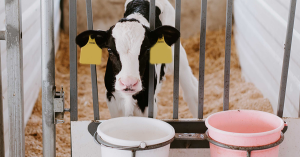
4. Feed milk to cows and calves
- Over base milk can effectively be fed to cows, heifers, and calves.
- For calf feeding, pasteurization is required.
- For heifers and cows, please review the following guidelines: Feeding Unpasteurized Milk to the Dairy Herd
5. Use milk as fertilizer
- Considering milk is high in P, N, K and other nutrients, it can be recycled and used as crop fertilizer.
- For environmental safety and farm viability, please review the following guidelines: Provisional Guidance: Using SurplusMilk as Fertilizer Due to the COVID-19 Emergency
The recommendations provided herein are based on current best practices. Individuals should determine the suitability of the information for their own particular operation and assume all responsibility associated with implementation.